
Yes, a bathroom can be remodeled in stages, but splitting the project does not automatically make it less expensive.
A phased bathroom remodel can make sense when the work separates cleanly. Painting the room this year and replacing a vanity later, for example, may create very little duplicated work. Rebuilding a shower now and planning to move its plumbing during a second phase is different. Part of the completed bathroom may need to be opened again.
That is the central question homeowners should ask before dividing a renovation:
Can each phase be completed without interfering with work that will need to happen later?
If the answer is yes, phasing can spread expenses and decisions over time. If the answer is no, doing the work in stages can mean paying twice for demolition, protection, labor, finishing, permits, mobilization, or materials.
For homeowners in Massachusetts and New Hampshire, the best approach depends less on how many phases the project has and more on where the boundaries between those phases are placed.
What Is a Phased Bathroom Remodel?
A phased bathroom remodel divides the renovation into separate projects rather than completing the entire room during one continuous construction period.
A homeowner might replace the shower first, then install a new vanity and lighting the following year. Another project might begin with necessary plumbing or moisture repairs while cosmetic improvements are postponed.
This is different from the normal sequence of a full bathroom renovation.
Every complete remodel already happens in stages: demolition comes before rough plumbing, rough work before wall finishes, waterproofing before shower tile, and so on. Those activities are still part of one coordinated project.
A phased renovation intentionally stops between portions of the work, sometimes for weeks, months, or even years.
Why Homeowners Consider Remodeling in Stages
Budget is an obvious reason, but it is not the only one.
A homeowner may need to address a failing shower immediately while the rest of the bathroom remains functional. Someone may want to postpone expensive cabinetry. A family might need to limit how much of the house is disrupted at once.
Sometimes the long-term bathroom plan simply has not been finalized yet.
Phasing can accommodate those circumstances, but only if today’s work does not create obstacles for tomorrow’s renovation.
When Does Remodeling a Bathroom in Stages Work Well?
The easiest projects to divide are those where each portion of the bathroom functions relatively independently.
Think of the bathroom as a collection of systems rather than a collection of products.
A mirror can often be changed independently. Plumbing behind a tiled shower cannot.
Cosmetic Work Can Often Be Separated
Painting is one of the simplest examples.
If the walls are in good condition and future construction will not disturb them significantly, repainting the bathroom does not commit the homeowner to a major construction decision.
Replacing certain accessories, mirrors, or decorative fixtures can work similarly.
Even these improvements require some foresight, however. Painting immediately before a major renovation scheduled a few months later may simply mean painting twice.
The question is not whether something can be done separately. It is whether separating it provides any real benefit.
A Vanity Replacement May Work as Its Own Phase
Replacing a vanity can be a practical standalone improvement when the basic bathroom layout will remain unchanged.
The project becomes more complicated if the future renovation includes moving the sink, changing plumbing locations, replacing flooring underneath the cabinetry, installing wall tile behind the vanity, or redesigning electrical and lighting locations.
A vanity installed today may have to come out again later.
That does not necessarily make the first phase a mistake, but the homeowner should know about the duplication before making the decision.
An Urgent Repair Can Become Phase One
Not every homeowner begins a remodel because the bathroom looks outdated.
Sometimes a shower is leaking, flooring has failed, or another condition needs attention before the household is ready for a complete renovation.
Addressing the problem first can be reasonable.
The important distinction is between repairing a problem properly and applying a temporary finish over a condition that will eventually require more extensive work.
If demolition exposes deterioration, our guide to water damage during a bathroom remodel explains why identifying the source and extent of the problem should come before rebuilding the affected area.
The Best Phase Boundaries Follow Construction Boundaries
This is one of the most useful ways to evaluate a phased remodel.
Do not divide the project only according to products:
- Shower this year.
- Vanity next year.
- Floor after that.
Instead, ask which construction systems connect those products.
The floor may continue underneath or around the vanity. Plumbing may connect work on several walls. Electrical changes can affect lighting, receptacles, mirrors, and ventilation. Tile may span areas intended for different phases.
A good phase ends at a point where the completed work can remain largely untouched when the next phase begins.
Think About What Will Be Behind the Finished Surface
Walls and floors are particularly important.
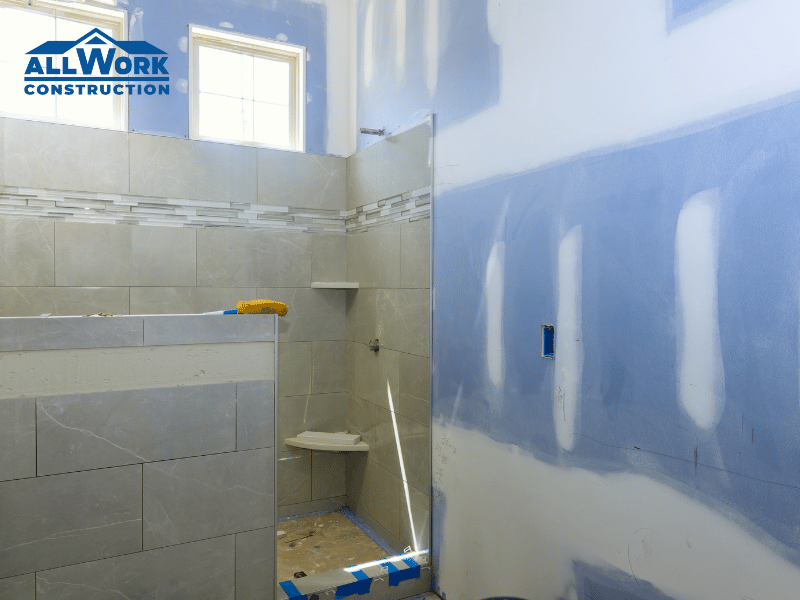
Finished surfaces can make future changes considerably more complicated. Plumbing adjustments or additional structural blocking may require reopening a wall that has already been completed, while changing the footprint of existing cabinetry can expose unfinished sections of a recently installed floor. Tile creates a similar challenge because accessing anything behind it may mean removing and later rebuilding part of the finished surface.
When Can a Phased Bathroom Remodel Cost More?
The potential additional cost usually comes from duplicated work, not simply from waiting.
A contractor completing the entire bathroom once can coordinate demolition, rough work, inspections, wall preparation, finishes, and installation as one project.
Separate the same scope into multiple projects, and some of those activities may need to happen more than once.
Demolition May Have to Be Repeated
Imagine replacing the vanity and repairing the wall around it during phase one.
A year later, the homeowner decides to relocate the sink as part of a larger layout change.
The finished wall may have to be opened again.
The homeowner effectively paid to finish a surface that was later demolished.
Site Protection and Setup Happen Again
Bathroom remodeling involves more than work inside the bathroom.
Contractors may need to protect floors and adjacent spaces, bring tools and materials into the home, establish work areas, manage debris, and clean the site.
With one continuous renovation, those activities are coordinated once.
With several independent projects, portions of that setup can repeat.
No individual item necessarily creates a dramatic difference, but repeated project overhead can make the combined cost of several phases higher than completing the same scope together.
Finish Work Can Be Duplicated
Drywall repair, painting, trim, caulking, and touch-ups often occur near the end of a project.
If another phase later disturbs those areas, some finishing work has to be repeated.
The same issue can occur with tile.
Removing a few tiles later sounds simple until matching material, waterproofing continuity, substrate preparation, and surrounding finishes are considered.
Material Matching Gets Harder Over Time
A tile available today may be discontinued next year.
Even products sold under the same name can sometimes differ between manufacturing batches.
Cabinet finishes, flooring, hardware, grout, countertops, and fixtures can also change or disappear from product lines.
If future phases need to match existing work exactly, waiting introduces another variable.
One practical solution is to purchase enough critical finish material for anticipated future repairs or transitions when the first phase is completed.
Plumbing Is One of the Biggest Factors in Deciding Whether to Phase the Project
Moving plumbing after finished surfaces are installed can undermine much of the financial benefit of phasing.
Suppose phase one includes a new floor and vanity.
Phase two will eventually include a larger shower that requires changing the drain location and modifying supply plumbing.
Whether those projects can remain independent depends on where the plumbing runs and what must be opened to reach it.
This is why decisions about moving plumbing during a bathroom remodel should ideally be made as part of the long-term plan, even when the plumbing work itself will not happen immediately.
Toilets Deserve Particular Attention
Changing a toilet model is one thing.
Relocating the toilet is another.
A future toilet relocation can affect the floor system, drain configuration, surrounding finishes, and potentially the room below.
If relocation is part of the long-term design, installing expensive new flooring around the current toilet as an isolated first phase deserves careful consideration.
The Shower Is Usually Difficult to Treat as a Temporary Project
A shower is not simply tile, glass, and fixtures.
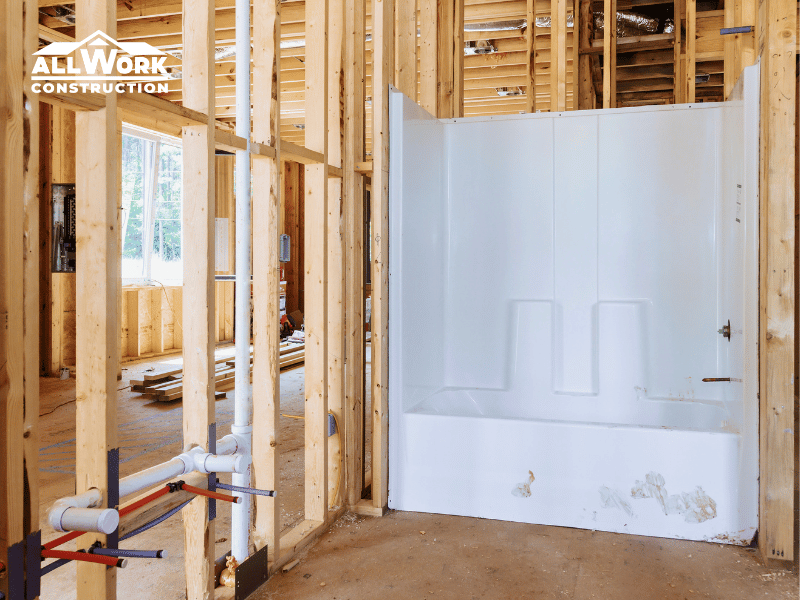
Behind the visible finish is a system involving substrate preparation, waterproofing, drainage, plumbing, transitions, penetrations, and surrounding surfaces.
For that reason, a shower renovation should usually be treated as a complete assembly rather than partially upgraded with the expectation that major hidden components will be changed later.
Avoid Paying for the Same Shower Twice
Consider a homeowner who wants a new shower immediately but expects to enlarge it in two years.
Installing a complete tiled shower now and demolishing part of it later can be an expensive way to reach the final design.
If the existing shower can safely remain in service, waiting may make more sense.
If it cannot, the better question may be whether the long-term shower design should be completed during the current project rather than installing an intentionally short-lived version.
A tub-to-shower conversion can work as a defined renovation phase when that shower configuration is intended to remain part of the final bathroom.
Flooring Can Either Support Phasing or Make It Difficult
Flooring frequently connects otherwise separate areas of a bathroom.
A homeowner may want to install new flooring now while postponing the vanity.
Will the new floor extend beneath the future vanity?
Will the future vanity have the same footprint?
Could the toilet move later?
Will a future shower change alter the floor transition?
These details matter.
Continuous Flooring Can Preserve Flexibility
In some designs, extending appropriate flooring beneath cabinetry can make future changes easier because a different vanity footprint will not expose an unfinished section.
That is not a universal rule. Installation requirements depend on the flooring system and cabinetry.
The larger principle is to avoid accidentally locking the future design into today’s cabinet dimensions.
Electrical Work Should Be Planned Beyond the Current Phase
Replacing a light fixture is often straightforward.
Redesigning the vanity wall is not.
A future bathroom plan might include two sconces, a larger mirror, a medicine cabinet, additional receptacles, new switching, or different ventilation controls.
If phase one closes or refinishes the wall without considering those plans, phase two may reopen it.
Plan Hidden Infrastructure Early
This does not mean every future fixture has to be purchased now.
It means the eventual layout should be understood well enough that today’s construction does not work against it.
The same principle can apply to blocking behind walls for future accessories or other planned installations.
What is inexpensive while a wall is open can become much more disruptive after tile or finished drywall covers it.
Can You Remodel a Bathroom in Stages to Save Money?
It can reduce the amount of money that needs to be spent at one time.
That is not the same as reducing the total project cost.
This distinction matters.
Suppose a complete bathroom renovation costs more than the homeowner wants to commit to this year. Dividing the project can make the immediate expense manageable.
If the combined phases eventually cost more because of repeated labor and duplicated work, phasing may still accomplish the homeowner’s financial objective.
The homeowner is essentially choosing cash-flow flexibility over maximum construction efficiency.
Prioritize Work That Prevents Damage
If budget requires phasing, necessary construction should generally take priority over purely cosmetic improvements.
An active leak should not be postponed so that new decorative fixtures can be installed first.
A deteriorated subfloor should not be hidden under new flooring.
Ventilation or moisture problems deserve consideration before expensive finishes are added.
The first phase should leave the bathroom in a sound condition, not simply make it look newer.
A Phased Remodel Still Needs a Final Plan
One of the biggest mistakes is treating every phase as an independent decision.
The homeowner replaces the vanity first.
A homeowner might start by replacing the vanity, select new flooring several months later, and eventually decide to enlarge the shower. By that point, the revised layout may reveal another problem: the existing door swing now interferes with the space they have created.
Each decision may have made sense individually, but no one designed the finished room.
Design the Destination Before Choosing the Route
Even if construction will take place over several years, create a basic final plan first.
Determine the likely fixture locations.
Decide whether the bathtub will remain.
Establish the intended shower footprint.
Consider vanity size.
Think through flooring.
Identify major lighting and electrical changes.
You do not necessarily need to purchase every product immediately.
You need enough information to make sure phase one does not make phase three unnecessarily difficult.
This is where professional bathroom remodeling planning can be valuable even when the entire renovation is not being completed at once.
What Should Be Done in the First Phase?
There is no universal sequence because bathrooms begin in different conditions.
However, a useful priority system is:
First: Active Problems
Address leaks, deterioration, unsafe conditions, moisture problems, or failed components that can cause additional damage.
Second: Hidden Infrastructure That Affects Future Work
If walls or floors are already open, consider plumbing, electrical, ventilation, framing, and other concealed work that is part of the final plan.
Closing a wall only to reopen it during the next phase rarely improves efficiency.
Third: Permanent Layout Decisions
Major fixture locations should be resolved before expensive finishes make them difficult to change.
Fourth: Durable Finished Assemblies
Complete areas such as showers in a way that allows them to remain intact during future phases.
Fifth: Independent Cosmetic Improvements
Paint, certain accessories, mirrors, and similar items can often wait until later without affecting the underlying renovation.
The sequence should follow construction dependencies rather than whichever product is most exciting to replace first.
When Does a Full Bathroom Renovation Make More Sense?
Phasing becomes less attractive when most of the bathroom’s major systems are interconnected.
If the project involves new flooring, shower reconstruction, plumbing relocation, vanity replacement, electrical changes, wall repairs, ventilation improvements, and new finishes, separating those activities may create more disruption than benefit.
A full bathroom renovation allows those systems to be coordinated as one construction sequence.
It can also make demolition more efficient because hidden conditions are exposed once rather than incrementally.
One Construction Period Can Be Easier on the Household
Cost is not the only consideration.
Three separate projects can mean three periods of dust, noise, contractor access, material deliveries, and bathroom downtime.
A single renovation may be more disruptive initially, but once it is finished, construction is finished.
For households with another usable bathroom, completing the work together can sometimes be easier than repeatedly putting the same room back into construction.
When Does Phased Remodeling Make the Most Sense?
Phasing tends to work best when the answer to several questions is yes:
Can phase one remain untouched during phase two?
Does each phase leave the bathroom fully functional and properly finished?
Are major plumbing locations already decided?
Are future fixture footprints understood?
Will new flooring and tile work with the eventual design?
Are we avoiding temporary work that will later be demolished?
Do the financial or scheduling benefits justify any duplicated labor?
If several answers are no, the project may not divide naturally.
How Change Orders Can Affect a Phased Remodel
Phasing does not eliminate uncertainty.
In some situations, it can create more opportunities for the project scope to change because conditions and product decisions are addressed at different times.
For example, the first phase may reveal plumbing that affects the planned second phase. A product selected for future work may become unavailable. The homeowner’s priorities may change after using the remodeled portion of the room.
That makes documentation important.
Our guide to bathroom remodel change orders explains how changes to scope, materials, price, and schedule should be handled when a renovation moves away from the original plan.
A long-term phased project benefits from the same principle: document what has been completed and keep the final plan updated as decisions change.
Phasing Older Massachusetts and New Hampshire Bathrooms Requires Extra Planning
Older New England homes can make phased renovation particularly interesting because the visible bathroom may tell only part of the story.
Floors may have multiple layers.
Previous owners may have renovated different parts of the room at different times.
Plumbing may have been modified during earlier projects.
Walls and framing may not behave like those in a newer house.
That does not mean an older bathroom cannot be renovated in stages.
It means phase boundaries should be chosen carefully.
If the first phase requires substantial demolition and exposes important concealed conditions, it may be worth completing related hidden work before the room is closed again.
The goal is to avoid repeatedly opening the same construction.
For All Work Construction, planning a phased bathroom remodel means looking beyond the work being completed today and considering how it connects to the homeowner’s eventual bathroom.
Before Splitting the Project, Compare Two Scopes
Homeowners considering phasing should ask a contractor to think through two scenarios.
Scenario A: Complete the planned renovation as one project.
Scenario B: Divide it into the phases being considered.
Then identify what gets repeated.
Does demolition happen twice?
Will finished drywall be reopened?
Will plumbing need to be accessed again?
Could flooring need patching?
Will permits or inspections be handled separately?
Will another construction setup and cleanup be necessary?
Are products being installed now likely to be removed later?
This comparison is more useful than simply asking whether a bathroom can be remodeled in stages.
In most cases, it can.
The important question is whether this particular bathroom should be.
The Best Phased Remodel Is Planned as One Bathroom
A bathroom does not need to be completed all at once to be planned all at once.
That distinction can prevent many of the problems associated with phased renovation.
Establish the final layout first. Understand which plumbing and electrical locations will eventually change. Identify permanent surfaces. Decide which finished assemblies should never need to be reopened. Then divide construction at points where one completed phase can remain intact while the next begins.
Sometimes that approach makes phased remodeling a practical solution.
Other times, drawing the complete plan reveals that the proposed phases overlap so heavily that completing the renovation together is more efficient.
Either result is useful.
The objective is not to finish everything as quickly as possible. It is to avoid spending money today on work that the next phase will have to undo.