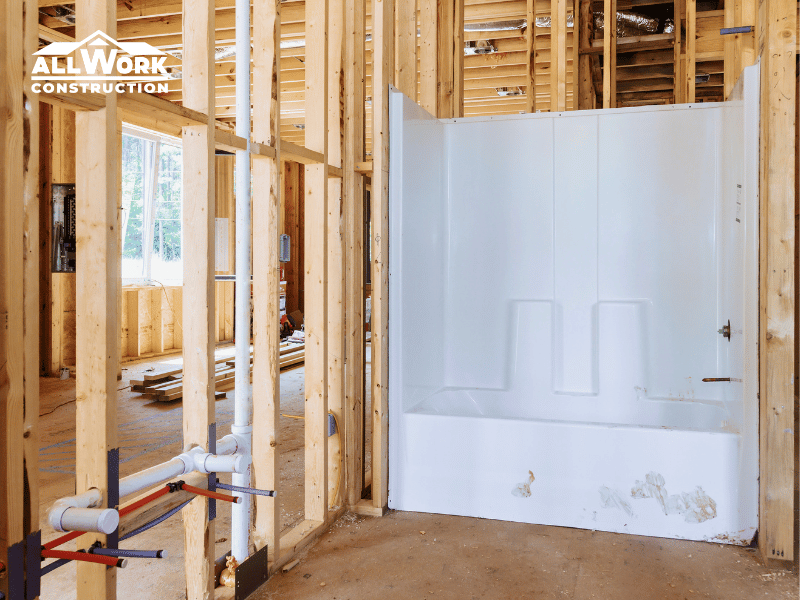


A bathroom remodeling contract may begin with a clearly defined scope, selected materials, an agreed price, and a construction schedule. Then demolition starts and something changes.
The subfloor beneath the toilet is deteriorated. A homeowner decides to upgrade the shower glass. An inspection identifies work that needs to be corrected. The selected vanity is no longer available, and the replacement costs more. Or the homeowner realizes that moving an outlet now would make the finished bathroom substantially more convenient.
These situations have one thing in common: the work being performed is no longer exactly the work originally agreed upon.
That is where a change order comes in.
A bathroom remodel change order is generally a written modification documenting a change to the project’s original scope, price, schedule, materials, or another contract term. A change order is not automatically evidence that something went wrong. Changes can arise from concealed conditions, homeowner decisions, code or inspection requirements, product substitutions, or details that could not reasonably be confirmed before construction.
What matters is how those changes are identified, priced, approved, and documented.
For Massachusetts homeowners in particular, written documentation has additional importance. State guidance says home-improvement contracts over $1,000 must be written, and Massachusetts’ sample contract guidance states that modifications to the original contract must be in writing and agreed to by both parties.
What Is a Change Order in a Bathroom Remodel?
Think of the original contract as the baseline for the project.
It should describe what the contractor has agreed to provide: demolition, construction work, materials, fixtures, finishes, project price, payment arrangements, and other relevant details.
A change order modifies that baseline.
For example, the original scope might include:
“Remove the existing tub and install a new tub in the existing location.”
After construction begins, the homeowner may decide to replace that arrangement with a tiled walk-in shower.
That is not simply a small preference discussed on site. The new direction could change demolition, plumbing, waterproofing, tile quantities, shower glass, labor, materials, cost, and schedule.
A written change order creates a record of what is changing.
A good change order answers more than “How much extra?”
At minimum, homeowners should be able to understand:
What changed?
Why did it change?
What additional or reduced work is involved?
How does it affect the price?
Could it affect the schedule?
Has the revised work been authorized?
A dollar amount without a clear description of the revised scope leaves too much room for misunderstanding.
Not Every Change Order Means the Contractor Missed Something
One of the biggest misconceptions about change orders is that every one represents poor estimating.
Sometimes that is true. A vague proposal or inadequate planning can create avoidable changes later.
But bathrooms contain substantial concealed construction.
Before demolition, a contractor can inspect the visible room, take measurements, discuss known conditions, and evaluate accessible areas. They cannot necessarily see every section of subfloor, every concealed pipe, or every previous repair without opening finished surfaces.
That creates a meaningful distinction between unforeseen conditions and work that should reasonably have been included in the original scope.
Example: hidden subfloor damage

Imagine that the existing bathroom looks dry.
There is no obvious active leak, and the finished flooring does not reveal the condition beneath it.
After the toilet and flooring are removed, a section of subfloor is found to be deteriorated from an older leak.
The original remodel may not have included replacing that damaged section because its condition was concealed.
Repairing it changes the work required.
That is a legitimate reason for a potential change order.
Compare that with predictable work.
Now imagine the contract clearly includes replacing the existing vanity, but installation labor for the vanity was somehow omitted from the price.
That is a different situation.
Homeowners should not assume every request for additional payment is justified merely because it is called a change order.
The question should always be:
Is this genuinely new or changed work compared with the signed scope?
The Five Most Common Types of Bathroom Remodel Change Orders
Most changes during a bathroom renovation fall into a few broad categories.
Understanding them helps homeowners distinguish unavoidable discoveries from decisions that can often be prevented through better planning.
1. Hidden Conditions Discovered During Demolition
Bathrooms are particularly vulnerable to concealed problems because water, plumbing, and multiple layers of finished materials exist in a relatively small area.
Demolition may reveal:
- deteriorated subfloor;
- water-damaged framing;
- evidence of an old leak;
- unexpected plumbing configurations;
- previous repairs;
- damaged wall material;
- or other concealed construction conditions.
The important step is not immediately assuming that everything exposed needs replacement.
The contractor should first determine what has actually been found and how it affects the planned work.
Documentation matters here.
If an unexpected condition results in additional work, homeowners should be shown what was discovered whenever practical.
Photographs can be particularly useful.
The explanation might be:
After removing the existing shower, deterioration was found in this section of the subfloor. The original scope assumed the existing subfloor could remain. This change covers removal and replacement of the affected section before the new shower is installed.
That provides much more information than an invoice line saying:
Extra floor work: $X.
Our guide to water damage during a bathroom remodel goes deeper into what should happen when demolition exposes moisture-related deterioration.
2. Homeowner-Requested Changes
Not all change orders begin with a construction problem.
Sometimes the homeowner changes their mind.
That is normal.
The issue is that decisions that appear small can have consequences beyond the price difference between two products.
“Can we change this while you’re here?”
Suppose the original project includes a standard showerhead.
During construction, the homeowner decides they want a handheld shower plus a separate rainhead and additional controls.
The fixtures themselves may cost more, but that may not be the only difference.
The change could affect rough plumbing, wall preparation, fixture locations, installation labor, and possibly the schedule if new components have to be ordered.
Timing changes the cost of a decision.
Making that decision before plumbing rough-in may be relatively straightforward.
Making it after the wall has been closed and tiled is completely different.
The product choice may be identical.
The amount of completed work that has to be modified is not.
This is one reason pre-construction selections are so important.
3. Code, Permit, or Inspection-Related Changes
Bathroom remodeling can involve plumbing, electrical work, ventilation, structural conditions, and other regulated work.
The exact permit and inspection requirements depend on the project and jurisdiction.
Sometimes existing conditions become visible during construction and require attention before the project can proceed as planned.
Existing work can complicate a new renovation
A contractor may open a wall and discover previous work that does not match what was expected.
An inspector may also identify an issue affecting the permitted work.
The appropriate response depends on the condition and applicable requirements.
This is why a change should be explained specifically rather than described vaguely as “code work.”
Homeowners should understand what was found, what requirement applies, and what work is proposed.
For Massachusetts projects, the state emphasizes detailed written home-improvement contracts and contractor responsibility for necessary construction-related permits under its HIC framework.
4. Material and Product Changes
Bathroom renovations depend on numerous products arriving in the correct dimensions, finishes, and configurations.
Vanities, tile, faucets, shower valves, tubs, toilets, mirrors, lighting, hardware, and shower glass all have to coordinate.
A product can become unavailable.
Delivery can be delayed.
A homeowner may choose an upgrade.
Or a selected item may turn out to be incompatible with another part of the design.
A substitution is not always financially neutral
Suppose the specified vanity becomes unavailable and the homeowner approves another model.
If the replacement has the same cost and installation requirements, the impact may be minimal.
But a different vanity could require:
- plumbing adjustments;
- a different countertop;
- changed mirror dimensions;
- relocated lighting;
- or modifications to surrounding finishes.
The meaningful question is not only, “Does the replacement vanity cost more?”
It is, “What else does this substitution change?”
Finalize major selections before demolition when possible.
Product decisions made early allow the contractor to check dimensions and coordinate related work before the bathroom is open.
That does not guarantee every product will remain available.
It does substantially reduce decisions being made under construction pressure.
5. Scope Clarifications and Design Changes
This category is where a detailed original contract becomes especially valuable.
Consider the phrase:
“Renovate the shower.”
What exactly does that include?
Demolition?
New valve?
New drain?
Waterproofing?
Tile to the ceiling?
A niche?
Shower glass?
If two parties interpret the same line differently, the project can encounter a disagreement even though neither believes they changed the scope.
Specific proposals reduce gray areas
Compare the vague description above with a scope that identifies what will be removed, what will be installed, which materials are included, and which components are excluded or supplied by the homeowner.
The second version requires more work before signing.
It can save substantial confusion later.
Massachusetts consumer guidance similarly emphasizes that home-improvement contracts should contain a detailed description of the work and materials, along with price and payment information.
What Should a Bathroom Remodel Change Order Include?
Change orders do not need to become complicated legal documents for homeowners to understand them.
They do need to be specific enough to answer the obvious questions.
Description of the change
The document should identify what is being added, removed, substituted, or modified.
For example:
Replace approximately X square feet of deteriorated subfloor discovered after demolition.
is more useful than:
Additional carpentry.
Reason for the change
Was hidden damage discovered?
Did the homeowner request an upgrade?
Did a selected product become unavailable?
Was the scope modified following an inspection?
The reason provides context.
Price adjustment
The change order should indicate how the contract price changes.
Not every change increases the price.
Removing work from the scope can potentially create a credit, depending on the circumstances and contract.
Changes can go both directions.
Suppose a homeowner decides not to install a feature included in the original scope before materials are ordered or work begins.
That may result in a reduction rather than an addition.
Thinking of change orders only as “extra charges” misses half of their purpose.
They document modifications to the agreement.
Schedule impact
Some changes have little effect on the completion date.
Others can stop an entire phase of work.
If a newly selected faucet has a three-week lead time and tile cannot be completed until related plumbing decisions are resolved, the schedule may change even if the installation itself is minor.
Where the impact is known, it should be discussed along with cost.
Approval
A clear approval process helps prevent one of the worst remodeling conversations:
“I thought that was included.”
versus
“I thought you approved the extra.”
Massachusetts’ sample HIC contract guidance expressly says modifications to the original contract must be in writing and agreed to by both parties. Massachusetts Government
Allowances and Change Orders Are Not the Same Thing
These two concepts are often confused.
An allowance generally reserves an amount within the contract for an item that has not yet been finally selected or priced.
A change order modifies the agreed work or contract terms.
Consider a tile allowance
Suppose the contract contains a defined allowance for tile.
If the homeowner later chooses tile priced above that allowance, the difference needs to be accounted for according to the contract.
That does not mean the original estimate was necessarily wrong.
The homeowner selected a product above the budgeted amount.
Allowances should still be realistic
An unrealistically low allowance can make the initial proposal appear less expensive than the project is likely to become.
Homeowners should therefore ask what each allowance is expected to cover and whether it reflects the type of product they are considering.
A proposal with fewer unknowns generally makes the final project cost easier to understand.
Can Change Orders Be Avoided Completely?
Probably not on every renovation.
The better goal is to eliminate preventable change orders while having a clear process for legitimate ones.
A bathroom that has not been opened in decades may contain conditions that neither the homeowner nor contractor could fully verify beforehand.
No amount of product selection can reveal every concealed condition.
But many other changes can be reduced substantially.
How to Reduce Change Orders Before Construction Starts
The most effective time to control change orders is before demolition.
Once trades are working and materials are being installed, changing direction becomes more expensive.
Make major design decisions early
Determine the intended layout.
Decide whether the tub stays.
Decide whether plumbing will move.
Determine the shower configuration.
Select the vanity size.
Understand mirror and lighting relationships.
These decisions affect one another.
Changing one late can create a chain reaction.
Finalize products that influence rough work
A decorative towel hook can usually wait longer than a shower valve.
Products affecting plumbing, electrical locations, framing, cabinetry, or dimensions deserve priority.
That includes items such as:
- shower systems;
- tubs;
- vanities;
- sinks;
- faucets;
- toilets;
- medicine cabinets;
- lighting;
- and certain built-in accessories.
Knowing those specifications early reduces improvisation during construction.
Read the scope, not only the total price
A remodeling estimate should not be evaluated solely by the number at the bottom.
Homeowners should understand what that number buys.
Is demolition included?
Who supplies fixtures?
What tile work is included?
Does the shower price include glass?
Is painting included?
Who handles permits?
What happens if hidden damage is discovered?
The more questions answered before signing, the fewer opportunities there are for different assumptions later.
Ask What Is Specifically Excluded
This question is remarkably useful:
“What is not included in this price?”
Exclusions often reveal project boundaries more clearly than another paragraph describing included work.
If shower glass, painting, specialty fixtures, or unforeseen structural repairs are excluded, homeowners can plan accordingly rather than discovering those boundaries halfway through construction.
A Change Order Should Not Be a Surprise Invoice
There is an important difference between an unexpected construction condition and an unexpected bill.
A hidden condition may genuinely be impossible to identify before demolition.
The homeowner can still be informed before additional work proceeds whenever circumstances allow.
A better sequence looks like this
The contractor identifies the condition.
The homeowner is shown or receives documentation of it.
The contractor explains why it affects the agreed scope.
The proposed solution is defined.
Cost and known schedule effects are communicated.
The change is approved according to the contract.
Then the revised work proceeds.
That process turns an unexpected condition into a managed project decision.
Emergency situations can be different
There can be situations where immediate action is needed to prevent further damage or address a safety issue.
The project’s contract and circumstances matter.
But those exceptions should not become an excuse for routinely performing substantial extra work first and discussing the price later.
What If the Homeowner Disagrees With the Change Order?
Start with the original scope.
The most productive question is usually not:
“Why are you charging me extra?”
It is:
“Where does this work fall relative to what we originally agreed to?”
That brings the discussion back to documentation.
Compare three things
First, what does the signed contract say?
Second, what condition or request created the proposed change?
Third, what new work is now being proposed?
If the original contract clearly included the work, the contractor should be able to explain why an additional charge is being requested.
If the work is genuinely outside the original scope, the homeowner should be able to see the distinction.
A detailed contract makes this conversation substantially easier.
How Change Orders Affect the Bathroom Remodel Timeline
Cost receives most of the attention, but schedule effects can be equally important.
Some changes add only a few hours of labor.
Others interrupt the sequence of several trades.
Imagine that demolition reveals a damaged subfloor in the shower area.
The new shower cannot simply be installed over it.
The repair needs to happen first.
That can shift waterproofing, tile work, glass measurement, and other downstream activities.
One delayed decision can affect several later steps
The same thing happens with homeowner changes.
If a different shower valve is selected after rough plumbing begins, work may need to pause while the new product arrives.
The direct labor required to install it may be relatively small.
The schedule consequence may be larger.
This is why the bathroom remodel timeline depends not only on how much work is involved but also on the sequence in which decisions and construction activities occur.
When Change Orders Become a Warning Sign
Change orders themselves are normal construction documents.
A pattern of poorly explained changes is different.
Homeowners should pay attention when additional charges repeatedly appear without clear scope descriptions, when work is performed before authorization without a reasonable explanation, or when items that appeared to be included in the original proposal are continually reclassified as extras.
Too many changes may point back to the original planning
A remodel that changes constantly can indicate:
- an incomplete initial scope;
- unresolved design decisions;
- inadequate product planning;
- unclear allowances;
- communication problems;
- or a project that began before enough information was available.
Some older bathrooms genuinely produce surprises.
That does not explain every change.
The distinction is important.
How All Work Construction Approaches Changes During a Bathroom Remodel
A bathroom renovation should have a defined starting scope, but remodeling an existing home is different from assembling a new product in a factory.
Existing construction matters.
Homeowner decisions matter.
What demolition reveals matters.
For All Work Construction, the purpose of documenting a project change is to keep the revised work understandable: what changed, why it changed, and how the change affects the project.
That becomes particularly important in Massachusetts and New Hampshire homes where older bathrooms may have gone through previous renovations that are not obvious until finishes are removed.
The objective of professional bathroom remodeling is not to promise that a project can never change.
It is to plan thoroughly enough that avoidable changes are reduced and legitimate changes can be handled without turning the project into a series of financial surprises.
Five Questions to Ask Before Approving a Change Order
Before approving additional work, a homeowner should be able to answer five questions.
1. Why is this change necessary?
Understand whether it comes from a hidden condition, homeowner request, product change, inspection issue, or clarification of scope.
2. Was this work included in the original contract?
Read the relevant portion rather than relying on memory.
3. What exactly will be done differently?
The revised work should be specific enough to understand.
4. What is the financial impact?
Know the adjustment before approving the work whenever circumstances reasonably allow.
5. Will it change the schedule?
A modest price adjustment can still have a significant timing consequence if materials must be reordered or completed work needs modification.
Those questions do not make a homeowner difficult.
They make the project easier to document.
Good Change-Order Management Starts Before There Is a Change
The best change order is not necessarily the one that never happens.
In renovation, some changes reveal that the project team discovered something important and addressed it rather than covering it up.
The real objective is predictability.
A homeowner should know what was originally included. Product selections should be made early enough to coordinate the work. Allowances should be understandable. Hidden conditions should be documented. Requested upgrades should be priced before they quietly become part of the job. Changes should be connected back to the original agreement.
That turns a change order from a mysterious additional charge into what it is supposed to be:
a documented adjustment to a project whose scope has changed.