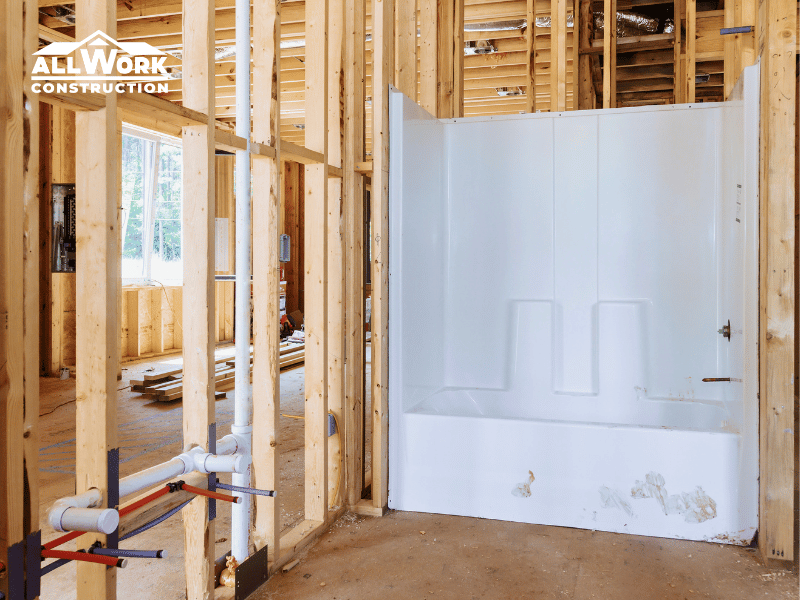

Bathroom demolition sometimes changes the direction of a renovation within a few hours.
The old shower comes out, a section of flooring is removed, and suddenly there is darkened plywood around the toilet, deteriorated material beside the tub, staining inside a wall, or framing that does not look the way anyone expected.
Finding water damage during a bathroom remodel does not automatically mean the renovation has become a major reconstruction project. It does mean the affected area needs to be understood before it disappears behind new finishes.
This is especially relevant in Massachusetts and New Hampshire, where many homes have bathrooms that have been renovated more than once. A newer vanity or tile floor can sit on top of much older plumbing, subflooring, framing, or previous repairs.
The right response is not to panic and replace everything nearby. It is to determine where the moisture came from, whether the source is still active, how far the damage extends, and what actually needs to be repaired before construction continues.
Why Water Damage Is Sometimes Discovered Only After Demolition
Some bathroom moisture problems announce themselves early. A ceiling below the bathroom develops a stain. Flooring becomes soft around the toilet. Paint repeatedly peels beside the shower.
Other problems remain hidden.
Water can reach the area below a shower, around plumbing penetrations, beneath flooring, or behind wall finishes without producing an obvious symptom on the finished side of the bathroom.
A previous owner may also have repaired the visible result without correcting the source.
That is why demolition should be treated as more than removal. During a professional bathroom remodel, it is also the first opportunity to see parts of the room that may have been inaccessible for decades.
A beautiful bathroom can still have damaged material underneath.
New-looking finishes do not tell you much about what is behind them.
A bathroom may have received new flooring ten years ago without anyone removing the older layers below it. A shower surround might have been installed over an existing assembly. Trim can conceal deteriorated edges around a tub.
In older New England homes, several generations of renovation can make the construction history particularly difficult to understand from the surface.
Once demolition exposes the underlying structure, assumptions can finally be replaced with evidence.
First Question: Where Did the Water Come From?
Finding damaged material is only half the problem.
The source matters more.
Replacing a section of deteriorated subfloor while leaving an active leak above it creates a temporary repair. New materials can eventually develop the same problem.
A contractor therefore needs to work backward from the damage.
Possible sources include a leaking toilet connection, plumbing supply or drain problem, shower enclosure failure, deteriorated caulking at a vulnerable location, previous overflow, condensation, or water escaping from the shower area.
The pattern of damage can sometimes provide clues, but the cause should not be assumed simply from appearance.
Old damage and active damage require different responses.
Not every stain discovered during demolition means water is currently entering the structure.
A leak may have happened years ago and already been repaired. The material could now be completely dry.
That does not necessarily mean damaged material should remain. Structural condition still matters. But distinguishing an old event from an active moisture problem helps determine what should happen next.
The contractor should answer two separate questions:
Is moisture still entering this area?
Then:
Has the affected material lost the condition or strength required for it to remain?
Those questions prevent two opposite mistakes: covering an active problem because the surface feels dry today, or unnecessarily rebuilding sound construction because an old stain looks alarming.
What Happens If the Bathroom Subfloor Is Rotted?
Subfloor damage is one of the more common discoveries homeowners worry about during bathroom demolition.
Bathrooms expose flooring assemblies to risks that most other rooms do not. Toilets, tubs, showers, plumbing connections, and repeated wet use all occupy a relatively small space.
When deterioration is discovered, the important question is not simply whether the plywood looks discolored.
The contractor needs to determine its physical condition.
Discoloration does not automatically mean structural failure.
Wood can show evidence of previous moisture without being structurally unsound.
Conversely, material that does not look dramatic from above may have softened or deteriorated enough that it is no longer an appropriate substrate for the new bathroom.
This becomes especially important when tile is planned.
Tile assemblies perform best over a properly prepared, sufficiently stable substrate. Installing expensive new tile over a compromised floor transfers an old problem directly into a new renovation.
Localized damage may allow a localized repair.
Suppose deterioration is concentrated around a toilet because of a previous leak.
If the surrounding subfloor and supporting structure are sound, the appropriate repair may be limited to that affected area.
The entire bathroom floor does not automatically need reconstruction.
The same principle applies near a bathtub or shower.
The repair should follow the actual extent of damage rather than an arbitrary distance from where the first damaged section was found.
What if the damage extends into the framing?
This changes the conversation.
Once deterioration reaches joists, wall framing, or other structural components, the contractor needs to evaluate the affected construction before proceeding with normal bathroom work.
The solution depends on what is damaged, how severely it is affected, and the way that part of the house is constructed.
Older homes can make this more complicated because framing may already contain notches, holes, repairs, or modifications from previous plumbing installations.
This is one reason opening a bathroom in Massachusetts or New Hampshire can reveal more than the homeowner expected even when the finished room looked relatively normal.
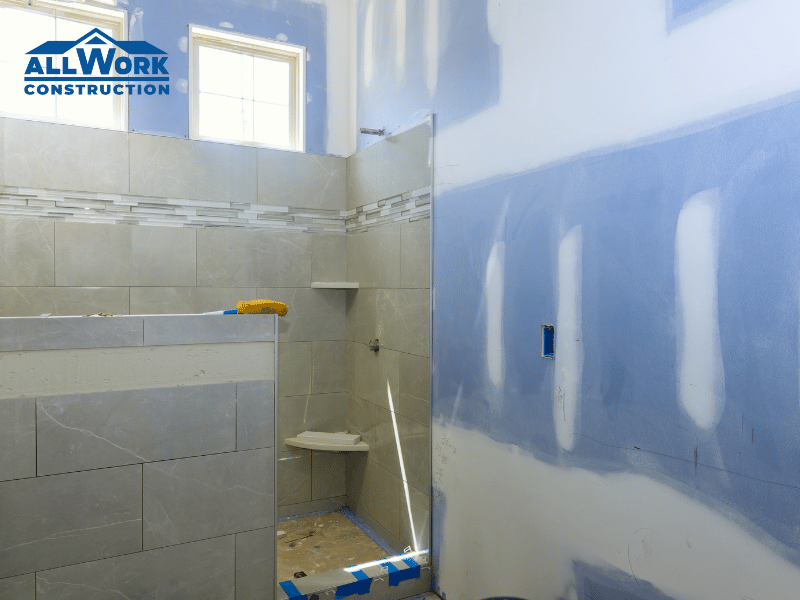
What If Water Damage Is Found Behind the Shower?
A tiled shower hides almost everything that protects the surrounding house from water.
Homeowners see tile and grout. The critical construction is behind them.
Modern shower assemblies rely on a coordinated system that manages water before it can reach vulnerable building materials. The exact system varies by installation, but the principle is consistent: the decorative surface is not the only line of defense.
Tile and grout are not the waterproofing strategy.
This distinction is important.
Grout can absorb moisture, joints require appropriate treatment, and a tiled surface alone should not be expected to protect the wall structure indefinitely.
If demolition reveals deteriorated wall material, damaged sheathing, or moisture-affected framing around an old shower, simply installing new tile over the area would miss the reason the bathroom is being rebuilt.
The underlying shower assembly needs to be constructed correctly before the finished surface is installed.
That connects directly with one of the most important principles in bathroom construction: waterproofing is the part of a bathroom remodel homeowners rarely see once the project is finished, but its performance affects everything installed over it.
Pay attention to where the damage begins.
The location can help guide the investigation.
Damage concentrated near a shower curb can point the contractor toward different potential causes than deterioration around a plumbing penetration or along the edge of an enclosure.
Again, location alone does not prove the source.
It tells the contractor where closer examination should begin.
Does Finding Water Damage Mean There Is Mold?
Not necessarily.
Moisture damage and mold are related subjects, but they are not interchangeable.
The EPA explains that mold growth requires moisture and recommends addressing the source of the moisture as part of mold control. It also notes that areas affected by water should be dried promptly, generally within 24–48 hours where possible, to help prevent mold growth.
A darkened piece of wood, therefore, should not automatically be diagnosed as mold from appearance alone.
Likewise, the absence of obvious visible growth does not mean a moisture problem can be ignored.
What should happen if suspicious material is discovered?
The response should be proportionate to the condition.
If demolition exposes substantial or uncertain contamination, persistent moisture, or a situation beyond the normal remodeling scope, additional assessment or remediation may be appropriate before renovation continues.
For limited areas, the contractor can determine the appropriate next step based on the material, extent of damage, moisture conditions, and applicable requirements.
The important part is that the condition is addressed before it is concealed again.
Don’t turn every dark spot into a disaster.
Homeowners searching online after receiving a demolition photo can quickly encounter worst-case scenarios.
That is rarely helpful.
A small area of old staining, an isolated deteriorated section beside a toilet, and widespread active moisture damage are three very different situations.
They should not receive the same diagnosis or the same repair scope.
Water Damage Around a Toilet Often Tells a Specific Story
The toilet deserves its own discussion because damage around its base is relatively common and can remain unnoticed beneath finished flooring.
A toilet may appear stable and function normally while moisture has affected material below or around it.
If the toilet has been replaced previously, the area may also contain evidence of an older leak rather than a current one.
During demolition, removing the finished flooring provides a much clearer view of the condition of the subfloor and surrounding area.
The toilet flange and surrounding floor need to work together.
A new toilet should not simply be installed over a questionable floor because the damaged area will eventually be hidden again.
If the subfloor around the opening is compromised, it should be evaluated and repaired appropriately before the new finished flooring and toilet installation are completed.
This is one of those repairs that may add little visual excitement to a bathroom renovation.
It can nevertheless be far more important than upgrading a decorative fixture.
Water Damage Can Also Come From Outside the Shower
When homeowners hear “bathroom water damage,” they naturally think about plumbing leaks.
Bathrooms can experience moisture from other sources.
Condensation around a cold window, inadequate ventilation, exterior-envelope issues, or repeated water escaping onto the floor can all contribute.
That distinction becomes particularly important in New England.
Winter condensation can complicate the diagnosis
During a Massachusetts or New Hampshire winter, warm, humid bathroom air may encounter very cold surfaces.
A window can accumulate condensation after showers. Exterior walls may have colder sections. Poor bathroom ventilation can allow humidity to remain elevated longer than it should.
If deterioration is concentrated around an exterior wall or window, the contractor should avoid assuming that shower plumbing is responsible simply because the damage is located in a bathroom.
The source needs to fit the evidence.
This is also why ventilation, waterproofing, plumbing, and the building envelope should not be treated as interchangeable solutions. Each manages moisture in a different way.
How Does Hidden Water Damage Affect the Remodel Budget?
This is usually the next question after homeowners understand what has been found.
The frustrating answer is that hidden damage cannot always be priced accurately before it becomes visible.
A contractor can inspect the bathroom, discuss known conditions, and identify obvious risks before demolition. They cannot see through every finished floor and wall.
That does not mean unexpected repairs should become an open-ended blank check.
A good change should be documented
If hidden damage changes the original scope, the homeowner should understand what was discovered and why additional work is recommended.
Photographs are useful.
So is a clear description of the repair.
The homeowner should be able to distinguish between:
- work already included in the original contract;
- an unforeseen condition discovered after demolition;
- additional work required to correct that condition; and
- an optional improvement the homeowner decides to add at the same time.
Those categories should not be blurred together.
This is where change orders become important.
A legitimate hidden condition is one reason a bathroom remodel change order may occur.
For example, a proposal may reasonably include replacing the planned finish flooring but not rebuilding previously invisible deteriorated framing underneath it.
Once that condition is exposed, the additional scope can be documented before proceeding.
Our separate guide to bathroom remodel change orders will go deeper into how homeowners should evaluate those situations.
Does Water Damage Automatically Delay the Project?
Not always.
A small localized repair may fit into the construction sequence without dramatically changing the completion date.
More extensive damage can affect the schedule because the project may need time for investigation, drying, material replacement, additional trade work, or other necessary steps before the original renovation continues.
The biggest scheduling mistake is pushing ahead simply to preserve the original completion date.
If damaged material needs attention, covering it with a new floor or closing the wall to save a day is not a meaningful schedule improvement.
The project sequence may need to change
Imagine demolition was scheduled for Monday and rough plumbing for Tuesday.
If Monday reveals significant subfloor deterioration exactly where plumbing work is planned, the floor may need to be addressed before the project follows its original sequence.
A well-managed remodel adapts.
The schedule exists to organize construction. Construction should not ignore a real building condition just to protect the schedule.
Why Older New England Bathrooms Deserve Extra Attention
Massachusetts and New Hampshire contain homes from many different construction periods, and age alone does not determine whether a bathroom will have problems.
Renovation history can matter just as much.
A century-old home with a carefully rebuilt bathroom may present fewer surprises than a much newer property with poorly executed previous work.
That is why remodeling an older New England bathroom often involves understanding layers of construction rather than simply looking at the year the house was built.
Previous renovations can hide the original problem
A former owner may have installed new flooring over damaged material.
A shower may have been cosmetically updated without rebuilding the assembly behind it.
Old plumbing penetrations may remain from a previous layout.
None of this means homeowners should expect a disaster when renovating an older bathroom.
It means demolition should be approached carefully enough to identify what the new bathroom will actually rely on.
For homeowners considering bathroom remodeling in Massachusetts or bathroom remodeling in New Hampshire, local housing conditions make that investigative part of the project particularly valuable.
What Should a Homeowner Do When Damage Is Found?
The best response is surprisingly straightforward.
Do not immediately make decisions based on the most alarming photograph.
Ask the contractor to show you what was found and explain what is known so far.
Start with the source.
Has the source been identified?
If not, investigation should continue before the repair is finalized.
Establish the extent.
Is the problem limited to one section of subfloor, or does it continue underneath adjacent construction?
Removing only enough material to make the problem disappear from view is not the same as establishing its boundaries.
Determine what actually requires replacement.
Not every stained board needs to be discarded.
Not every visibly damaged material should remain.
The decision should reflect its condition and role in the construction.
Document the condition before closing the area.
Photographs of the exposed bathroom can be useful later, even after the problem has been repaired.
They create a record of what was found, what was accessible, and how the area looked before new finishes concealed it.
How All Work Construction Approaches Hidden Bathroom Damage
At All Work Construction, the objective after discovering hidden water damage is not to make the situation sound larger than it is.
It is to understand it before continuing.
If demolition exposes a damaged area, the next step should follow the evidence: identify the likely source, determine whether moisture is active, establish the extent of affected material, and decide what needs to be corrected so the new bathroom is being installed over suitable construction.
That may mean a relatively small repair.
In another home, it may require a more substantial change to the original scope.
Either way, homeowners should understand what changed and why.
This approach is particularly important throughout Massachusetts and New Hampshire, where existing bathrooms can contain decades of previous repairs and renovations beneath surfaces that appear perfectly ordinary.
The Best Time to Fix Hidden Water Damage Is When It Is No Longer Hidden
Nobody wants demolition to reveal an unexpected problem.
But if deteriorated material already exists beneath a bathroom, discovering it during a planned renovation is considerably better than leaving it underneath brand-new finishes.
At that moment, the room is already under construction. The affected area is accessible. The contractor can investigate the source, and repairs can be incorporated before the bathroom is rebuilt.
The goal should not be to turn every stain into a major project or to replace materials unnecessarily.
It should be to avoid building a new bathroom on top of a problem that has not been understood.
Once the source has been addressed and the affected construction has been properly evaluated, the renovation can continue with something the old bathroom may not have had for years: a known, sound foundation behind the finishes.